

Paper-based real estate transactions eat time. Serious time. Administrative tasks consume up to 75% of total transaction hours, roughly 30 out of every 40 hours spent per deal. That means agents, buyers, and sellers are buried in printing, scanning, faxing, and chasing wet signatures instead of closing deals. Electronic forms flip this equation entirely. They cut turnaround times from weeks to hours, reduce costly errors, and keep every party legally protected. This guide covers efficiency gains, compliance requirements, security advantages, cost savings, and real-world limitations, so you can make smarter decisions about going digital.
Table of Contents
- How electronic forms streamline real estate transactions
- How e-forms ensure legal compliance and reduce errors
- Security, privacy, and cost savings: E-forms versus paper
- What to know about limitations and best practices
- A fresh perspective: What most guides miss about digital forms in real estate
- Ready to streamline your transactions?
- Frequently asked questions
Key Takeaways
| Point | Details |
|---|---|
| Faster, simpler transactions | Electronic forms reduce time-to-close by automating workflow and eliminating paper delays. |
| Stronger legal compliance | E-forms ensure proper documentation, legal validity, and audit trails. |
| Enhanced security and cost savings | Digital workflows offer better data security and cut printing and shipping expenses. |
| Know the limitations | Some documents or scenarios still require wet signatures or hybrid approaches. |
| Process is as important as tech | True gains come when electronic forms are integrated with the right workflows and buy-in. |
How electronic forms streamline real estate transactions
The numbers tell a clear story. Case studies show 6x faster document turnaround, with timelines shrinking from two weeks down to two days or even two hours. The same data points to $25,000 in annual shipping savings and a 16% increase in signed contracts. Those are not small wins. That is a fundamental shift in how transactions operate.
For agents managing multiple listings at once, speed is currency. When a buyer is ready to move, waiting 48 hours for a wet signature can mean losing the deal. Electronic forms remove that bottleneck entirely. Documents go out instantly. Signatures come back fast. Deals move forward.
Here is a direct comparison of what paper versus electronic processing actually looks like:
| Metric | Paper process | Electronic process |
|---|---|---|
| Document turnaround | 5 to 14 days | 2 hours to 2 days |
| Courier/shipping cost | $500 to $2,000+ per year | $0 |
| Error rate | High (manual entry) | Significantly lower |
| Signing location | In person only | Anywhere, any device |
| Audit trail | None or manual | Automatic and timestamped |
The practical benefits stack up fast for every party involved:
- Agents can send, track, and manage contracts from a single dashboard
- Buyers can review and sign offers from their phone without scheduling an in-person meeting
- Sellers receive offers faster and can respond in real time
- All parties get automatic notifications when documents are opened, signed, or require action
NAR on electronic signatures confirms that e-signatures dramatically reduce the administrative burden that slows real estate workflows across the board. The time savings are real, and they compound across every transaction you run.
Exploring digital closing platform trends shows that the industry is moving fast in this direction, and agents who adopt early gain a measurable competitive edge.
Pro Tip: Set up automated reminders inside your e-form platform. When signers get a nudge at 24 and 48 hours, completion rates jump significantly. Batch your document sends at the start of each week to keep your pipeline moving without constant manual follow-up.
How e-forms ensure legal compliance and reduce errors
One of the biggest hesitations agents and sellers have about going digital is legal validity. The concern is understandable. Real estate contracts carry serious financial and legal weight. The good news is that the legal framework for electronic forms is rock solid.
Two federal and state laws form the backbone of e-signature validity in real estate. The federal ESIGN Act (Electronic Signatures in Global and National Commerce Act) and UETA (Uniform Electronic Transactions Act), adopted in 49 states plus Washington D.C., establish that electronic records and signatures carry the same legal weight as paper ones. Three conditions must be met: clear intent to sign, consent to use electronic records, and proper retention of those records. Meet those three requirements, and your e-signed documents are fully enforceable.
"Electronic records or signatures shall not be denied legal effect solely because they are in electronic form." This is the core principle behind both ESIGN and UETA, and it applies directly to real estate purchase agreements, disclosures, and addenda.
Beyond legal validity, the error reduction is dramatic. Digital closings deliver 79% fewer errors compared to paper processes, along with 83% improved borrower satisfaction and 82% gains in staff efficiency. Yet high adoption sits at only 14% despite 90% of U.S. lenders offering digital closings. That gap represents a major opportunity for agents who move now.
Here is what makes digital compliance in real estate so much stronger with electronic forms:
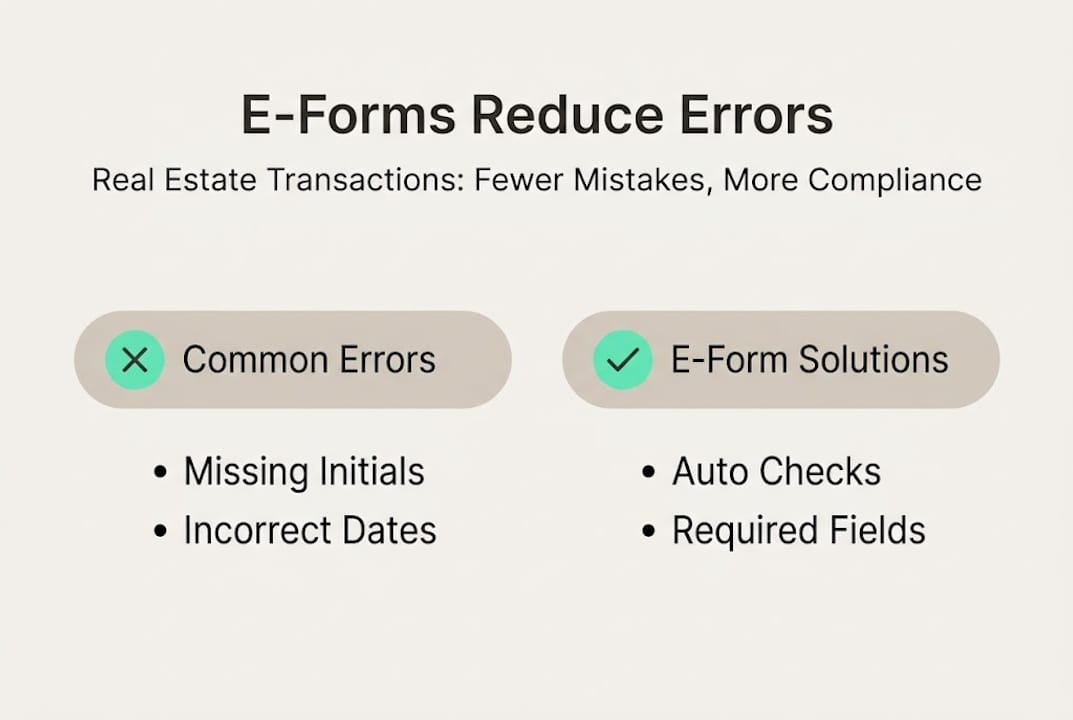
- Required field validation prevents submissions with missing data
- Version control ensures all parties are working from the same document
- Automatic audit trails log every action with timestamps and IP addresses
- Role-based access limits who can view or edit sensitive fields
- Consent capture is built into the signing flow, satisfying UETA requirements automatically
The result is fewer deals falling apart over missing initials, wrong dates, or unsigned addenda. Electronic forms guide signers through every required field before submission is allowed. That alone eliminates one of the most common causes of closing delays.
Security, privacy, and cost savings: E-forms versus paper
Paper documents are shockingly vulnerable. They can be lost in transit, altered without detection, or accessed by anyone who physically handles them. Electronic forms solve all three problems at once.
Modern e-form platforms enhance security through audit trails, encryption, tamper-proofing, and multi-party workflows. Each document gets a unique identifier. Every action is logged. SHA-256 cryptographic hashing detects any post-signature alteration instantly. If someone tries to change a number after signing, the system flags it.

Here is how the security and cost picture compares:
| Feature | Paper | Electronic |
|---|---|---|
| Tamper detection | None | SHA-256 hashing |
| Access control | Physical only | Role-based, password-protected |
| Audit trail | Manual or none | Automatic, timestamped |
| Printing costs | $500 to $3,000/year | $0 |
| Courier fees | $25 to $150 per document | $0 |
| Lost document risk | High | Near zero |
| Storage | Physical filing cabinets | Encrypted cloud storage |
The cost savings extend well beyond shipping. Consider what paper-based transactions actually cost:
- Printing and supplies for multi-page contracts, disclosures, and addenda
- Courier and overnight shipping fees for time-sensitive documents
- Physical storage costs for years of archived paper files
- Staff time spent scanning, filing, and retrieving documents manually
- Errors from manual handling that require reprinting and resending entire packages
Those costs add up fast across a full year of transactions. Switching to electronic forms eliminates most of them immediately.
Pro Tip: When evaluating platforms, prioritize document versioning and automated access logs. Versioning ensures you always know which draft is current. Access logs create a defensible record if any dispute arises over who saw what and when. These two features alone can protect you in a legal challenge.
Privacy protection is equally important. Encrypted cloud storage keeps sensitive buyer and seller data away from unauthorized eyes. Multi-factor authentication adds another layer. And unlike a paper file sitting in a filing cabinet, encrypted digital records are accessible only to credentialed parties.
What to know about limitations and best practices
Electronic forms are powerful. But they are not a universal solution for every situation. Knowing the limits protects you from costly mistakes.
Here are the key legal exclusions and process limitations you need to know:
- Wills and testamentary documents are generally excluded from ESIGN and UETA protections
- Certain family law documents may require wet signatures depending on state jurisdiction
- Court filings often require physical signatures or specific certified formats
- Some deeds may need physical witnessing or conveyancer certification depending on state-specific e-signature laws
- Remote online notarization (RON) rules vary significantly by state, affecting how closings can be conducted digitally
- Large file limits can cause problems with platforms not built for real estate-scale documents
- Version mismatches between parties using different software can corrupt document formatting
These are not reasons to avoid electronic forms. They are reasons to know your platform and your state's rules before you send.
Common mistakes agents make and how to fix them:
- Using generic e-sign tools not built for real estate: Switch to specialized real estate platforms that handle large PDFs, state-specific forms, and CRM integrations natively
- Ignoring version control: Always confirm all parties are working from the same document version before sending for signature
- Skipping stakeholder training: Low adoption often comes from tech resistance and poor buy-in, not the technology itself
- Choosing platforms without role-based access: Every party in a transaction should see only what they need to see
- Neglecting CRM integration: Standalone e-sign tools create data silos; integrated platforms keep everything connected
Some transactions will still require a hybrid approach. A deed that needs physical witnessing does not mean your entire workflow has to revert to paper. Handle the exception digitally where possible and use paper only for the specific requirement that demands it. Smart agents build hybrid workflows that minimize paper without ignoring legitimate legal requirements.
A fresh perspective: What most guides miss about digital forms in real estate
Most articles about electronic forms focus on features and compliance. That is useful. But it misses the real reason adoption fails.
The technology is not the problem. Process resistance is. When a brokerage rolls out a new digital platform without training, without buy-in from senior agents, and without integrating it into existing workflows, it fails. Not because the tool is bad. Because the people using it never fully committed.
True efficiency does not come from replacing PDFs with digital versions of the same broken process. It comes from integrating forms into your CRM, your transaction management, and your communication tools so that data flows automatically and nothing falls through the cracks. Platform adoption insights consistently show that agents who integrate fully outperform those who use e-sign as a standalone add-on.
Generic e-sign solutions built for general business use also fall short in real estate. They lack state-specific form libraries, large-file handling, and the compliance features that real estate transactions demand. Specialized platforms built for this industry are not a luxury. They are a necessity.
Ready to streamline your transactions?
Everything covered in this guide points to one clear conclusion: digital forms are not just faster, they are smarter. Fewer errors. Stronger security. Lower costs. Full legal compliance. The agents, buyers, and sellers who move to fully integrated digital workflows close more deals with less friction.

KeyChain real estate tools are built specifically for this. AI-powered contract drafting, encrypted digital signatures, NAR-compliant offer management, and collaborative transaction workspaces all live in one platform. Agents get full access for $20/month. Buyers join free. Whether you are closing your first deal or your five hundredth, KeyChain.ai gives you the digital infrastructure to do it faster, safer, and smarter.
Frequently asked questions
Are electronic forms legally recognized for real estate documents?
Yes, electronic forms and signatures are legally valid for most real estate transactions under the federal ESIGN Act and UETA, provided intent, consent, and proper record retention are all satisfied.
How do e-forms speed up the buying or selling process?
Electronic forms allow documents to be signed and processed in hours rather than days or weeks, with 6x faster turnaround documented in real-world case studies, which directly reduces closing delays and eliminates paperwork errors.
Are there any real estate documents that can't be electronic?
Yes, some deeds, wills, and certain court filings may still require physical signatures or witnesses due to state or federal exclusions that fall outside ESIGN and UETA protections.
What makes electronic forms more secure than paper?
E-forms use encryption, audit trails, and role-based access controls that make them far more resistant to tampering, unauthorized access, or physical loss than paper documents stored in filing cabinets.
Why haven't all real estate firms adopted electronic forms?
Many firms hesitate due to upfront costs, technology challenges, or slow stakeholder buy-in, even though the efficiency and cost savings are well-documented and available immediately upon adoption.